
My flight from berlin first takes me to Bonn.
I have 45 minutes to catch my flight…. get off … and at the airport there is no one…literally no one to guide one anywhere. Usually there are signs but this airport is confusing…… after walking around I see a cop…and she shakes her head and disgust and walks me to the exit and points… I go up…
and there is still chaos… after trying to ask 3-4 people, find out that they have closed gates B and C, from where my flight is to go… there has been some sort of security scare and around the gates there are crowds and no idea of what is going on
The officials start calling out names.. Bangkok flights…and hundreds pass quickly through the crowds to the gate..one by one the flights are called out… and get into the flight..2 hours late…no idea why or what happened…
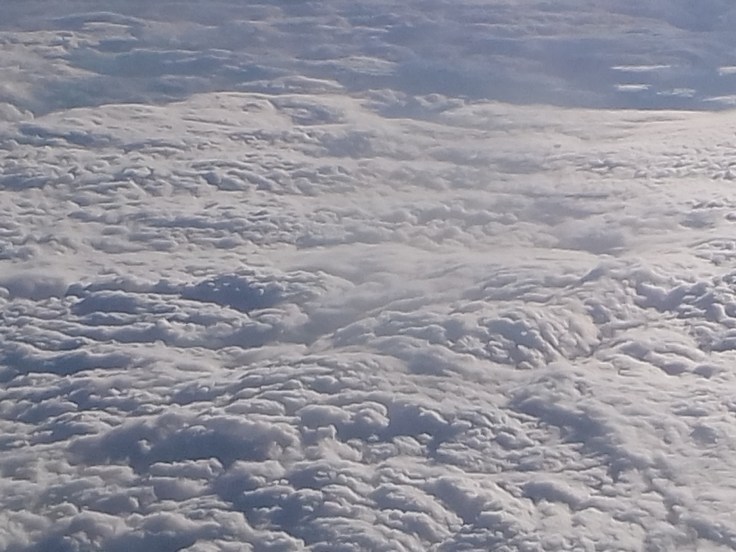
but the delay means that we are flying over the clouds with a setting sun and it is a mesmerising ride over clouds of many shapes and densities


In meteorology, a cloud is an aerosol comprising a visible mass of minute liquid droplets, frozen crystals, or particles suspended in the atmosphere above the surface of a planetary body.[1]


The droplets and crystals may be made of water or various chemicals. On Earth, clouds are formed as a result of saturation of the air when it is cooled to its dew point, or when it gains sufficient moisture (usually in the form of water vapor) from an adjacent source to raise the dew point to the ambient temperature.


They are seen in the Earth’s homosphere (which includes the troposphere, stratosphere, and mesosphere). Nephology is the science of clouds which is undertaken in the cloud physics branch of meteorology.


There are two systems of naming clouds in their respective layers of the atmosphere; Latin in the troposphere and mostly alpha-numeric above the troposphere. Cloud types in the troposphere, the atmospheric layer closest to Earth’s surface, have Latin names due to the universal adaptation of Luke Howard‘s nomenclature.
Formally proposed in 1802, it became the basis of a modern international system that classifies clouds into five physical forms and three altitude levels (formerly known as étages).
These physical types, in approximate ascending order of convective activity, include stratiform sheets, cirriform wisps and patches, stratocumuliform layers (mainly structured as rolls, ripples, and patches), cumuliform heaps, and very large cumulonimbiform heaps that often show complex structure.
The physical forms are cross-classified by the altitude levels to produce ten basic genus-types, most of which can be divided into species, and subdivided into varieties.”
thanks to Wikipedia


 Mira's Magical Mystical Tour